
The Torii Gate Symbol
One Gate, Two Worlds
The Torii marks the entrance to a sacred shrine and signifies the transition from the everyday world into a space of spiritual presence.
Passing beneath a torii represents moving into awareness of the kami — the sacred spirits or forces of nature honored in Shinto. The simple, open structure reflects harmony with nature, purity, and reverence for the divine as it expresses through the natural world.
More than an architectural feature, the torii embodies the idea that the sacred is both distinct and deeply woven into the landscape of daily life.
The History Behind the Symbol
The word torii translates literally to "bird gate," or "where birds perch." In its traditional form, a torii is built from two vertical posts (hashira) topped by two horizontal beams (kasagi and nuki) — a simple structure that has remained largely unchanged for centuries. While torii are most commonly built from wood or stone, modern and regional variations can also be found in bronze, steel, or concrete.
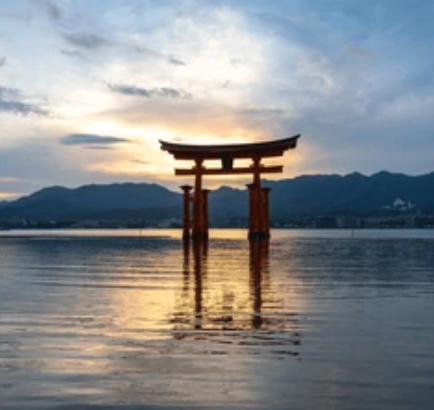
One of the oldest and most iconic examples is the great torii of Itsukushima Shrine, first constructed in the 6th century by Saeki no Kuramoto. Standing roughly 50 feet tall and built of decay-resistant camphor wood, the gate rises from the water off the island of Itsukushima — a name that translates to "island dedicated to the gods." The shrine is considered so sacred that, traditionally, births and deaths were not permitted to take place on the island itself.
Many torii are painted a bright vermillion red, a color historically believed to hold protective power, warding off evil spirits and impurity. Shinto shrines and their torii gates are frequently built in deep connection with the natural world — at the base of mountains, at the edge of forests, or beside rivers and the sea — reflecting the Shinto belief that kami inhabit the natural world itself. The Fushimi Inari Shrine in Kyoto offers a striking example of this: thousands of red torii gates, known as senbon torii, form a path winding up the mountainside, inviting visitors on a walking journey through the sacred landscape.
What the Symbol Teaches Us
The torii reminds us that sacred space is often marked by a threshold — a moment of conscious transition where we set aside the concerns of ordinary life and step into presence, reverence, and awareness. It teaches that the divine is not confined to temples or shrines alone, but can be found woven throughout the natural world, waiting to be noticed. To pass through a torii, literally or in spirit, is to pause, to purify one's intention, and to remember that the line between the everyday and the sacred is often thinner than we't think.
Explore more of the sacred symbols that inspire our community, or join us at CSL NOCO to experience these teachings in practice.