
The Khanda
The Balance of Truth and Justice

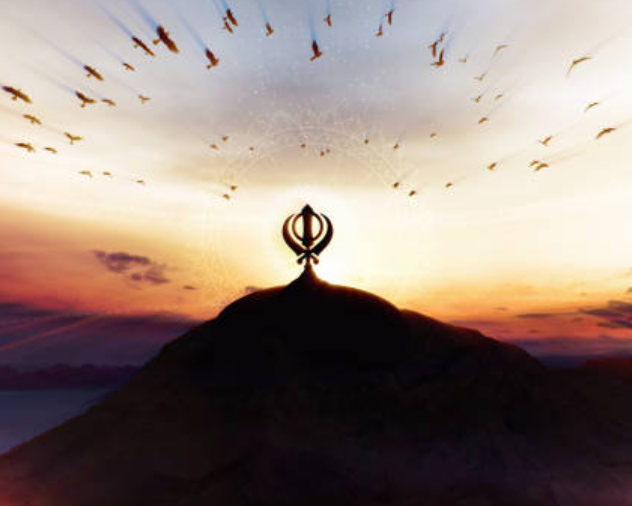
The Khanda is the primary symbol of Sikhism. It consists of three main elements: a central double-edged sword (the khanda), a circular ring (the chakkar), and two curved swords (kirpans) on either side.
The central sword represents divine truth and spiritual authority — the power of divine knowledge to cut through ignorance. The circle signifies unity, eternity, and the oneness of God without beginning or end. The two curved swords symbolize the balance between spiritual wisdom and responsible action in the world.
Together, the Khanda expresses unity, courage, justice, and the integration of spiritual devotion with ethical living.
The History Behind the Symbol
The Khanda, often called the Sikh coat of arms, evolved over time before reaching its current form around the 1930s during the Ghadar Movement. From the beginning, its elements — the double-edged khanda, the chakkar, and the crossed kirpans — expressed the integration of spiritual and temporal sovereignty, a concept known as Miri-Piri.
At the heart of the symbol, the double-edged khanda represents the dual aspects of Sikh philosophy: Miri, or temporal power, and Piri, spiritual authority. Flanking it, the two crossed kirpans symbolize the warrior code of the Khalsa and the balance between worldly duty and spiritual devotion. The chakkar encircling the whole design represents infinity — a reminder of the eternal nature of God's creation and the oneness of all humankind.
The Khanda also embodies the Sikh doctrine of Deg Tegh Fateh — "victory to charity and arms." Deg, the cauldron, reflects the Sikh commitment to langar, the tradition of offering free food to all people regardless of caste or creed. Tegh, the sword, represents the warrior spirit of the Khalsa, called to protect the oppressed and stand for justice.
This balance between temporal and spiritual life traces back to Guru Hargobind, who first articulated the concept of Miri and Piri — the idea that spiritual devotion and worldly responsibility are not opposites, but two swords meant to be carried together. Today, the Khanda continues to appear across Sikh art, jewelry, and clothing, remaining a living emblem of Sikh identity, courage, and the enduring teachings of Guru Nanak.
Explore more of the sacred symbols that inspire our community, or join us at CSL NOCO to experience these teachings in practice.